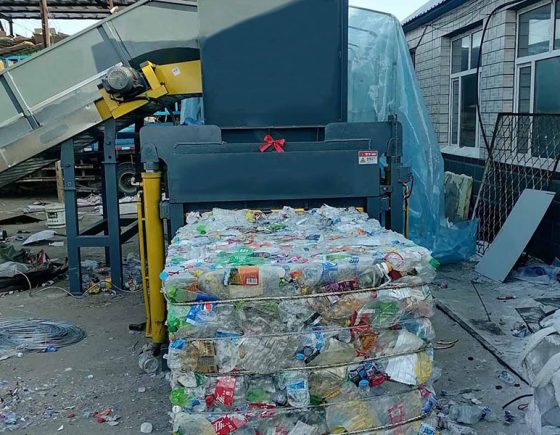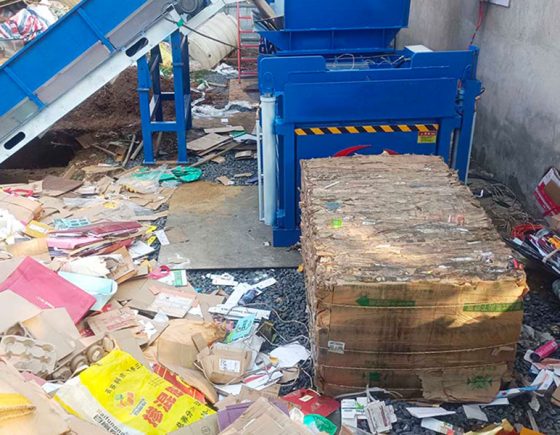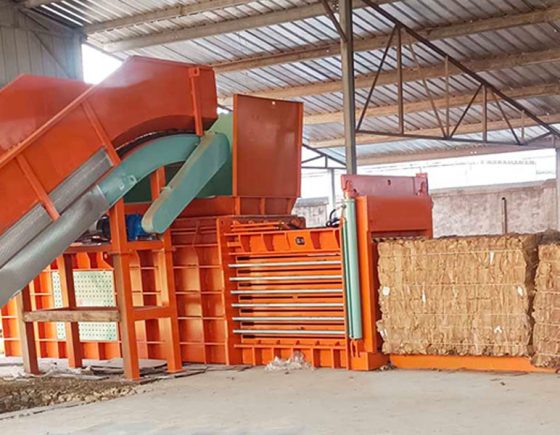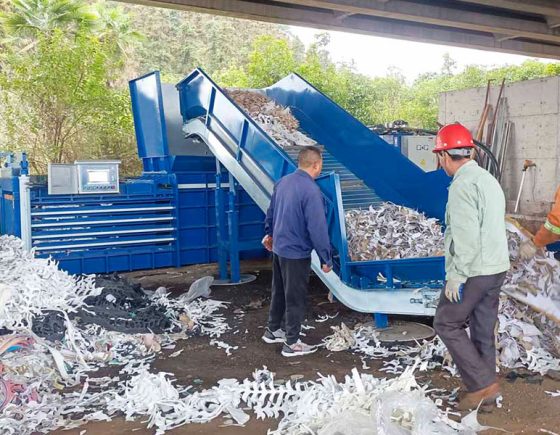
The plastic baling machine is a core guarantee for the efficient circulation of plastic recycling. Its application spans multiple dimensions of the plastic recycling process. For industrial-scale waste plastic recycling projects, baling machines are not merely auxiliary equipment for optimizing storage and transportation. They are core equipment that ensures the stable operation of subsequent processes and reduces overall costs.

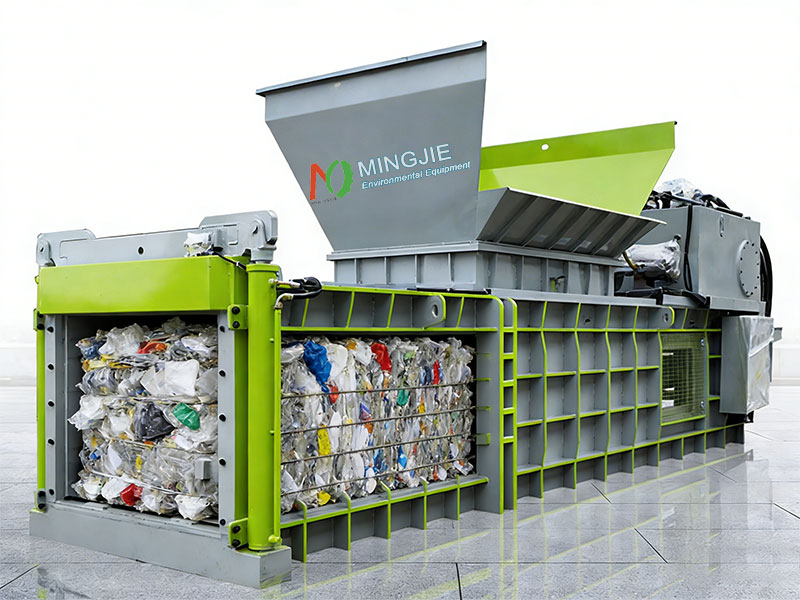
Plastic Baler for Warehouse Management
From a warehouse management perspective, waste plastics (such as plastic bottles, films, and plastic parts) are loose and bulky. Direct stacking would occupy a large amount of warehouse space and are susceptible to environmental factors, leading to secondary pollution.
Industrial plastic baler uses high-pressure compression technology to compress loose plastics into uniformly dense, standardized bales, significantly reducing their volume.
Horizontal baler can typically compress plastic volume to 1/5-1/8 of its original volume, significantly improving warehouse utilization. This also facilitates classified stacking and management, preventing secondary pollution from mixing different types of plastics. The plastic baling machine provides a guarantee for the consistency of raw materials in the subsequent crushing process.
Plastic Baling Machine for Transportation
In the transportation process, the role of balers becomes even more prominent. Transporting loose plastic is highly inefficient, and it is prone to scattering during transit, leading to road pollution and material loss.
Baled plastic blocks have high density and a fixed shape, allowing for standardized pallet stacking during transportation. This not only increases the loading capacity of transport vehicles but also reduces unit transportation costs.
Plastic Waste Baler for Recycling
For the crushing and melting regeneration process of aircraft plastics, plastic waste baler also plays a crucial role as a preliminary safeguard.
When uniformly compressed plastic bales enter the crusher, the feeding is more stable and even, preventing equipment blockage caused by excessively fast feeding of loose plastic. It also avoids energy waste due to equipment idling caused by slow feeding, improving the efficiency and stability of the crusher.
At the same time, the baling process can further remove hidden impurities such as metal and stones, reducing wear and tear on the crusher’s blades, screws, and other core components.
For industrial-grade continuous pyrolysis plant and its supporting recycling system, standardized bales can also achieve precise compatibility with subsequent automated feeding systems. This ensures the continuous and large-scale operation of the pyrolysis process, improving the overall stability of plastic-to-fuel production capacity.
In addition, the application of balers can improve the safety and standardization of the recycling process. Loose waste plastics are prone to bacterial growth and insect infestation, and some plastic films and foams pose a fire risk. Compression through baling reduces the environment for bacterial growth and lowers the risk of fire.
Furthermore, plastic balers facilitate weight calculation and batch management of raw materials for recycling companies. They provide support for the standardization and traceability of the company’s recycling process.